

Add Row
Add Element
affiliate success stories hub favicon image
update
Affiliate Success Stories Hub
update
Add Element
  • Home
  • Categories
    • Success Stories
    • Marketing Tips
    • Strategy Insights
    • Expert Interviews
    • Case Studies
    • Tools & Resources
    • Industry News
June 14.2025
2 Minutes Read

Unlock Success with Effective SEO Forecasting Strategies

SEO forecasting presentation with young man holding a calculator.


Boost Your SEO Game with Accurate Forecasting

As businesses increasingly scrutinize digital budgets, understanding and forecasting SEO performance is vital to showcasing the true value of your digital marketing efforts.


In this guide, we’ll explore how to effectively create an SEO forecast, ensuring you have the right tools to demonstrate growth and success.


The Importance of Data in SEO Forecasting

To kickstart your SEO forecasting journey, you'll need to gather essential data. Key components include:

  • 12 months of traffic data: Use platforms like Google Analytics or Search Console to analyze your organic traffic history.

  • Set targets: Establish what your future SEO performance should look like.

  • Keyword focus: Identify the keywords you plan to target in your campaign.

  • Click-through rate models: Develop models linking clicks to keywords to help gauge the potential traffic from SEO interventions.


This is crucial for predicting future outcomes and demonstrating the incremental value your strategies can offer—both to your organization and your clients.


Make Data-Driven Decisions for Future Growth

SEO forecasting isn't merely a one-time task; it's an ongoing process that continually adjusts as new data becomes available.
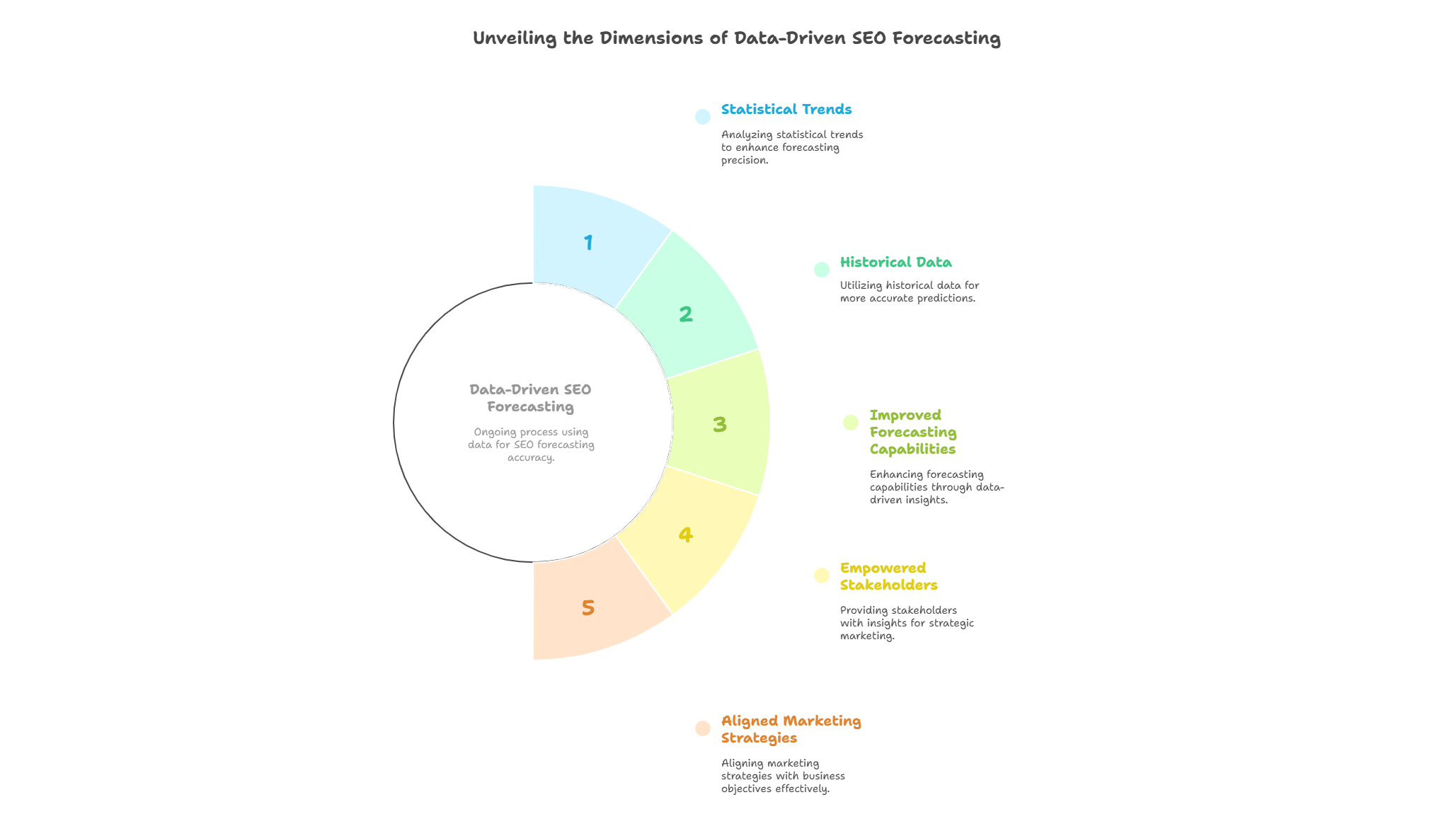

Chart showing 5 key elements of Data-Driven SEO Forecasting: Statistical Trends, Historical Data, Improved Forecasting Capabilities, Empowered Stakeholders, and Aligned Marketing Strategies


While it's difficult to predict the future with absolute certainty, leveraging statistical trends and real historical data brings you one step closer to accuracy.


By embracing a data-driven approach, you not only improve your forecasting capabilities but also empower your stakeholders with valuable insights to guide marketing strategies, ensuring your efforts are aligned with business goals.


Concluding Thoughts: Empowering Through Knowledge

In today's competitive landscape, the ability to forecast SEO success is no longer optional—it's essential.


Equip yourself with the right resources and knowledge, transform the way you approach your SEO strategy, and ensure that every decision you make is backed by data.


Remember, demonstrating value is key to securing the future of your digital marketing initiatives.


Strategy Insights

51 Views

0 Comments

Write A Comment

*
*
Related Posts All Posts
02.14.2026

Why You Need to Export GA4 Data to BigQuery for Effective Analytics

Update Unlocking Google Analytics 4: Why Export Data to BigQuery? The integration of Google Analytics 4 (GA4) and BigQuery is reshaping how organizations interact with their analytics data. By moving GA4 data to BigQuery, users not only retain their data indefinitely but also get around the interface limitations of GA4. Let's delve into the reasons why this powerful capability is essential for anyone serious about data-driven decision-making. Gain Unmatched Data Control One of the most prominent advantages of exporting GA4 data to BigQuery is the level of control it offers over your data. While GA4 provides a user-friendly interface for standard reporting, it imposes significant constraints. With BigQuery, you step into a realm where you can run complex SQL queries, gaining access to raw, unsampled data that allows for detailed customization. This means no more frustrating sampling or cardinality limits, ensuring precise insights into your digital landscape. Long-Term Data Retention: A Strategic Advantage Data retention poses a significant challenge in GA4, where user and event data is typically available for only up to 14 months. By exporting to BigQuery, you not only preserve your data but also enable historical analysis that can uncover long-term trends. This is especially beneficial for businesses looking to track their growth and user engagement over time. Customization and Flexibility for Functional Insights Once your GA4 data resides in BigQuery, the customization options are nearly limitless. For example, if you encounter bot traffic skewing your metrics, you can filter this out effectively. Customizing how you analyze sessions and events deepens your understanding of user behavior. Data-Driven Decisions in a Privacy-Conscious World In an era where privacy regulations are tightening, utilizing GA4 with BigQuery allows you to gather meaningful statistics from users who have opted out of tracking cookies. This way, you can still analyze essential metrics without compromising user privacy, thereby adhering to emerging legal standards while retaining valuable insights. Preparing for Future Analytical Challenges As tools like BigQuery evolve, they will unlock new analytical capabilities such as machine learning models and real-time personalization. Organizations that adopt this integration will be better equipped to respond to future data challenges and technological advancements. In conclusion, exporting GA4 data to BigQuery not only amplifies your analytical capabilities but also positions your organization for informed decision-making rooted in extensive historical data. As reliance on data grows, so does the need to leverage best practices in the realm of analytics.

01.27.2026

Rethinking SEO: Strategies to Build Authority in AI Search

Update The Shift in Search Dynamics: Navigating a New EraAs we step into 2026, the ways people discover content are evolving dramatically. Gone are the days when a simple Google search would suffice. Today, users are starting their search journeys on platforms like ChatGPT, TikTok, and Instagram, challenging brands to rethink their digital strategy. A fascinating report from Adobe highlighted a massive behavioral shift: 24% of Americans now kick off their inquiries using AI tools. This suggests that brands must not only be visible on traditional search engines but also across social platforms that younger audiences frequent.Why AI Search is Transforming VisibilityWith the rise of AI-driven searches, fewer clicks are being directed to websites, which means traditional SEO practices need to be reconsidered. In fact, a recent study by Seer Interactive revealed a staggering 65% drop in click-through rates when AI content showcases answers without citing the source. In this landscape, merely building backlinks for Google simply won't cut it anymore. Campaigns need to evolve by delivering multi-platform visibility and engagement.Strategies for Building Multi-Channel AuthorityEmbracing a multi-channel strategy allows brands to craft messages that resonate across various platforms, enhancing their authority. Mike King, a digital marketing expert, emphasizes identifying core topics and adapting content for each channel, whether it be video on YouTube, posts on LinkedIn, or quick hits on social media. This adaptation is crucial, as it builds engagement while reinforcing authority. Furthermore, employing tools like Brandwatch for social listening helps brands glean insights from their target audience, allowing for more effective campaign ideation.The Future of Brand VisibilityAs AI continues to shape how information is presented and consumed, brands that successfully adapt to these dynamics will not only survive but thrive. The key takeaway? It's essential to pursue brand authority beyond your website. By harnessing the power of integrated campaigns that use social media, influencer partnerships, and strategic PR, brands can ensure they're relevant and visible on any platform their audience encounters.Your Next Steps for Effective CampaignsTo leverage these insights, brands should focus on creating cross-channel content that solves real user problems. Experiment with various formats, engage meaningfully with audiences, and keep track of evolving trends in search behavior. With a robust strategy in place, your brand can build trust and authority, setting the stage for long-term success in the new digital landscape.

01.22.2026

Unlock the Power of Search Experience Optimization (SXO) to Boost Engagement

Update Understanding Search Experience Optimization (SXO) In today's digital landscape, it's not enough just to get clicks on your website; what happens after those clicks matter even more. Enter Search Experience Optimization (SXO)—a powerful approach that combines Search Engine Optimization (SEO) with User Experience (UX). This strategy is designed to not only attract visitors through higher rankings on results pages but also to keep them engaged once they arrive. With the rise of zero-click searches, where nearly 60% of Google queries don’t result in any click at all, creating an optimal user journey from search to conversion is more critical than ever. The Shift from Clicks to Engagement With traditional metrics like click-through rates becoming less relevant in the age of AI-driven search results, focusing on user engagement has taken center stage. SXO emphasizes understanding what users do after they land on your page: Are they scrolling? Interacting? Bouncing away? By utilizing tools like Microsoft Clarity and Crazy Egg, businesses can pinpoint where users encounter obstacles and optimize those experiences. Key Components of SXO SXO integrates various vital elements that contribute to a meaningful user experience. The first is the content itself. Quality matters more than ever—users expect informative, engaging, and valuable content that meets their needs. In addition, website design must prioritize user navigation, ensuring that information is easy to find and interact with. Remember, an aesthetically pleasing design aids retention! By streamlining checkout processes and enhancing mobile-friendliness, you not only appeal to visitors but also convert them into loyal customers. Measuring Success Beyond Engagement Success in SXO transcends basic metrics like traffic volume. Instead, businesses need to delve into engagement metrics, such as average time on page and bounce rates, to fine-tune their strategies. A longer time spent on a website typically indicates higher engagement, while high bounce rates signal a need for improvement. Analyzing these metrics allows brands to make informed decisions that enhance the user journey. The Future of Search: What SXO Means for Brands As we continue to navigate a landscape influenced by AI and emerging technologies, incorporating SXO into your digital strategy is vital. This holistic approach can lead to increased user satisfaction and, ultimately, better conversion rates. By prioritizing user experience alongside traditional SEO tactics, brands can create a sustainable online presence that not only attracts visitors but retains and converts them.

Terms of Service

Privacy Policy

Core Modal Title

Sorry, no results found

You Might Find These Articles Interesting

T
Please Check Your Email
We Will Be Following Up Shortly
*
*
*