Add Row
Add Element
affiliate success stories hub favicon image
update
Affiliate Success Stories Hub
update
Add Element
  • Home
  • Categories
    • Success Stories
    • Marketing Tips
    • Strategy Insights
    • Expert Interviews
    • Case Studies
    • Tools & Resources
    • Industry News
June 06.2025
2 Minutes Read

Unlocking SEO: Real-Life Analogies Everyone Can Relate To

Educational graphic on real-life analogies to explain SEO with illustrations.


Understanding SEO Through Everyday Analogies

SEO, or Search Engine Optimization, can often feel like navigating a complex maze filled with technical jargon and intricate details.


For those just stepping into the field, such as myself when I joined Salience Search Marketing, the learning curve can seem steeper than a mountain.


A fun and effective way to demystify these concepts is through analogies that relate to our daily experiences.


Websites as Houses: A Familiar Framework

A helpful analogy is to envision a website as a house. Just as each element of a house plays a crucial role, so does every component of a website. For example:


  • HTML is the foundation: Think of HTML as the bricks that create the structure of a house. Without a solid foundation (HTML), no home (website) can stand nor be functional.


  • CSS is the design: CSS serves as the paint and interior design that beautifies the house. While bricks and structure are essential, a well-decorated home invites guests (visitors) to come in and explore.


Bringing Clarity to Technical SEO

When I first encountered code, it seemed overwhelming, but likening it to construction work made it tangible. By breaking down complex processes like technical SEO—where elements must work together for visibility on search engines—becomes easier.
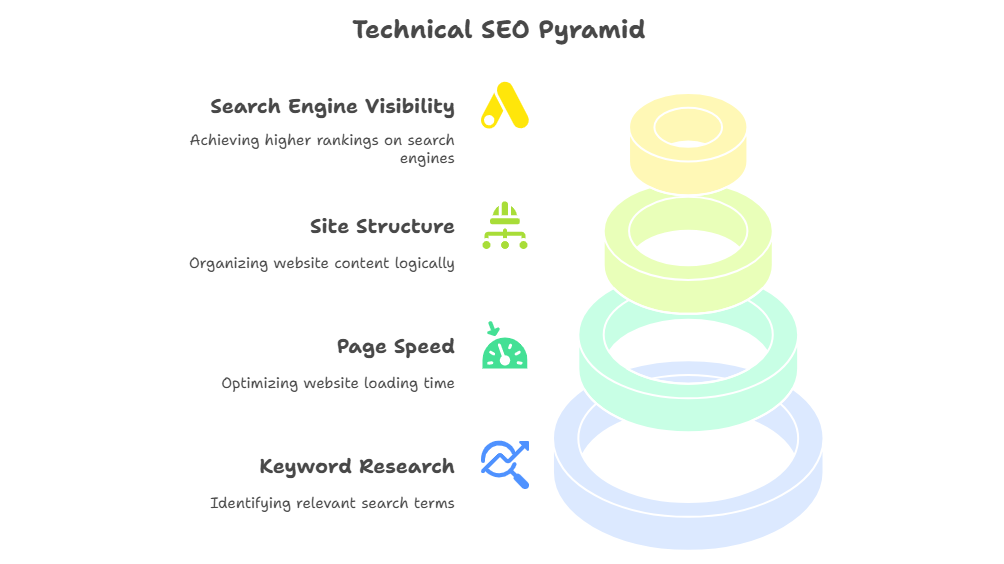


Technical SEO Pyramid showing four layers: Keyword Research, Page Speed, Site Structure, and Search Engine Visibility, each with brief descriptions


For instance, just as different tools are used in construction, each aspect of SEO plays its part; keyword research, page speed, and site structure all have to be finely tuned.


The Human Side of Technology

At its core, SEO is about connecting people with information. The algorithms that dictate search rankings are designed to help search engines understand what users want and deliver it effectively.


In this light, think of SEO not just as a technical aspect but as a bridge linking human queries with digital content.


Key Takeaways for Beginners

For those new to SEO, using analogies not only makes learning easier but also helps explain these concepts to others.


Whether you are teaching, learning, or simply looking for better ways to understand and engage with SEO, these comparisons can illuminate the complexities of technical SEO.


For example, engaging in workshops or informal discussions can enhance understanding, making it less daunting.


In a world increasingly governed by digital interaction, harmonizing technology with the human experience can foster a greater understanding of how improvements in SEO can bring forth not just visibility, but genuine connections.


Tools & Resources

39 Views

0 Comments

Write A Comment

*
*
Related Posts All Posts
01.24.2026

Discover How ChatGPT Atlas is Transforming Web Browsing with AI

Update What is ChatGPT Atlas? OpenAI's ChatGPT Atlas is revolutionizing the way we navigate the internet by integrating unique AI capabilities directly into a web browser. Unlike traditional browsers, ChatGPT Atlas is designed to be your personalized assistant, providing contextual and intelligent interactions as you browse. How Does ChatGPT Atlas Work? At its core, ChatGPT Atlas operates using an innovative architecture known as O.W.L., which seamlessly connects the browser functionalities with the language model of ChatGPT. This allows it to effectively understand user intent while browsing, making it easier to find specific products, services, or information. For instance, if you're looking for the best running shoes, you not only search but also converse with ChatGPT on what specific needs and features are relevant to you. Key Features of ChatGPT Atlas ChatGPT Atlas is packed with numerous features that set it apart from other browsers: Embedded ChatGPT: Every new tab grants access to ChatGPT, allowing you to query without switching contexts. Agent Mode: This feature can autonomously perform tasks such as booking appointments or summarizing pages based on your browsing context. Built-in Memory: Atlas can remember past activities, enabling more personalized interactions as it updates its understanding based on user behavior. Context Awareness: It comprehends your current web page and previous interactions to provide tailored assistance. Pros and Cons of Using ChatGPT Atlas Despite its innovative features, ChatGPT Atlas is not without its challenges. Users have highlighted a few potential drawbacks: Inconsistent Responses: Sometimes, the answers provided by ChatGPT can be off-mark or not as pertinent as users would expect. Agent Mode Limitations: While powerful, agent functionalities can be sluggish and may lack accuracy compared to manual task execution. Privacy Concerns: As with any tool that compiles user data, there are considerations around the handling and security of your information. Future Implications The emergence of ChatGPT Atlas may signify a significant turning point in how we interact with technology daily. With AI becoming more integrated into our web navigation, we can expect future browsers to evolve into platforms that not only provide information but also assist in decision-making, thereby enhancing our productivity while online. Call to Action As AI technologies grow more sophisticated and accessible, consider exploring how ChatGPT Atlas can streamline your online experience. The blend of browsing with intelligent guidance can transform both personal and professional tasks, making it worthwhile to give it a try.

01.17.2026

Discover How to Vibe Code Your Own SEO Tools to Save Time

Update Unlocking the Secrets of Vibe Coding for SEO SuccessAre you overwhelmed by the tedious tasks that come with search engine optimization (SEO)? With the rise of artificial intelligence, particularly tools like ChatGPT, a new method called "vibe coding" is transforming the way SEO professionals build custom tools to streamline their workflows. Gus Pelogia's recent Whiteboard Friday discussion introduces novices and experts alike to the incredible potential of vibe coding. This innovative approach will not only save you time but also make your SEO tasks more enjoyable.What is Vibe Coding?At its core, vibe coding is about crafting simple, personalized tools that alleviate the monotony of routine SEO tasks. Instead of creating a grand software solution, Pelogia emphasizes the importance of developing small, effective tools that can enhance productivity. To embark on your coding journey, you will need three essential components: a large language model (LLM) such as ChatGPT, an API for connecting your tools, and a platform to run your code, like Google Colab or Google Sheets.Making the Most of Your ToolsThe key to effective vibe coding lies in writing precise prompts. Pelogia highlights the necessity of clarity in your code requests. Begin by specifying whether the output is for Google Colab or Sheets, and utilize APIs as needed. For instance, when using the OpenAI API to retrieve data, always outline your data structure - if you're inputting a URL in one column, be clear about that in your request. This straightforward breakdown not only streamlines the process but makes it more manageable for the AI to generate accurate output.Essential SEO Concepts for Vibe CodersUnderstanding basic concepts like vector embeddings and cosine similarity is crucial for producing high-quality tools. Vector embeddings convert words into numerical representations, providing context for models to comprehend relationships. Cosine similarity, on the other hand, helps to measure how closely related two pieces of content are based on their vector embeddings, allowing for nuanced analyses.From Ideas to Implementation: Automation in SEOAutomation is a game-changer in the SEO field, with tools capable of quickly and easily integrating into workflows. Pelogia suggests a few ideas for vibe coding projects that can simplify workflows, such as entity tracking and hreflang matching. By leveraging these automations, SEO professionals can spend less time on repetitive tasks and more on strategic initiatives that drive results.As AI continues to shape the industry, adopting vibe coding techniques opens the door to innovative solutions in day-to-day SEO work. Get started with these methods today to enhance your efficiency and accuracy in managing SEO tasks.

11.26.2025

Discover How AI Automation Tools Can Enhance Your Productivity

Update How AI Automation Tools Can Transform Your Daily TasksIn today's fast-paced digital landscape, businesses are continuously searching for ways to boost productivity and efficiency. Artificial intelligence (AI) has emerged as a powerful ally in this quest, offering innovative automation tools that facilitate a host of tasks from data analysis to project management.Unlocking the Benefits of No-Code AutomationsOne of the standout aspects of AI automation tools is their accessibility. Platforms like Promptitude.io and Thunderbit allow users who may not have coding skills to automate workflows easily. Imagine being able to connect various applications for automatic content generation or data analysis without writing a single line of code. With these tools, businesses can focus more on strategic initiatives rather than mundane tasks.Featured AI Tools for Enhanced EfficiencyLet's explore some of the most effective tools in the realm of AI automation. *Screendragon* stands out for its powerful AI-driven workflow management capabilities. Designed for seamless project execution, it enables teams to handle approvals, manage projects, and automate repetitive tasks effortlessly. Similarly, *Parabola.io* is best suited for data-heavy workflows, allowing teams to manage complex data tasks with ease and precision. These tools not only save time but also enhance overall operational efficiency.The Evolution of AI Workflow AutomationThe evolution of tools like Zapier and Make has shown how traditional automation methods can now be complemented with AI capabilities. Today’s AI-native solutions like Lindy and VectorShift go beyond simple triggers and actions. They allow users to create complex workflows involving interactions between multiple AI agents, leading to unprecedented levels of productivity. Imagine a scenario in which your email management system could autonomously categorize and respond to requests, freeing up valuable time and resources.Conclusion: Embracing the Future of WorkAs AI continues to advance, the tools available for workflow automation will only become more robust and user-friendly. Integrating AI automation tools into your daily operations could be the key to achieving higher productivity levels while minimizing the burden of repetitive tasks. So why wait? Start exploring these innovative solutions today to revolutionize how you work and interact with technology.

Terms of Service

Privacy Policy

Core Modal Title

Sorry, no results found

You Might Find These Articles Interesting

T
Please Check Your Email
We Will Be Following Up Shortly
*
*
*